Is a Secret Universe Hiding in a Single dot? “Cell”
The Unit of Life : Exploring the Art and Science of the Living “Cell”
A “cell” is the building block of life. Consider yourself holding the universe’s tiniest dot. It is smaller than the sentence’s final full stop. It’s a living dot. It is breathing, dreaming, and preparing to create the micro-universe’s masterpiece. We refer to that dot as a cell.
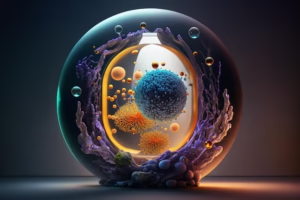
And it’s the start of each and every rose, firefly, elephant, and you. Just one cell. Only one. All life on Earth began there.
Both the mother and the father give half of a message when the baby is about to be born. The zygote is a tiny cell formed when those two halves unite.
The entire biological blueprint of life, including your eyes, smile, precise laugh, and perhaps even your favourite color, is stored in that one cell. In a matter of hours, that cell starts to divide and differentiate, dividing into two, then four, then eight, like the most patient artist applying one meticulous brushstroke after another.
One cell gradually grows into a hundred trillion cells cooperating like the world’s greatest orchestra in the warm, dark environment of the mother’s womb. And nine months later, a baby—a living, breathing rainbow created from a single invisible dot—cries for the first time.
When Science and Art Paint the Masterpiece of Life-
The Microscope Gallery
When science grabs a paintbrush known as the microscope, the real magic show starts. Place a regular onion skin under a lens and use a drop of iodine to stain it. The dull white onion abruptly transforms into a wall of flawless pink bricks that are arranged like tiles by the world’s greatest mason. When you look at a drop of your own blood, it turns into a river of millions of red doughnuts swimming with germ-fighting pale blue guards. Diatoms are tiny glass palaces that resemble stars, snowflakes, and wheels and shine with colors no painter has ever combined. They can be found in even a single grain of beach sand.
A picture of a zebrafish embryo glowing in a particular light caught my attention once. Its bones were green, its nerves electric blue, and its tiny heart bright red—this is the power of fluorescence…so amazing For five minutes, I was unable to speak. It was too lovely to speak out in words…
The First Nanotechnologists in Nature
Pigment is not used to paint butterfly wings. They are composed of millions of microscopic scales that use structural coloration to bend light. For this reason, even though the butterfly itself has no paint on its body, they shine electric blue, gold, or emerald. Nanotechnology was created by nature long before humans.
What about the tail of the peacock? Under a microscope, each eye-spot is a flawless piece of optical art, with feathers branching into ever-tinier filaments that reflect the geometry of living things until they become gentle rainbows that change color as his head moves.
The Grandness of Electron Microscopy
Scanning Electron Microscopy (SEM) of cells reveals monochromatic splendor:
- the hexagonal lattice of aquaporin channels in a kidney cell membrane,
- the crystalline elegance of virus particles arranged akin to Persian tiles,
- the fractal branching of Purkinje neurons that emulate the lightning in a nocturnal sky.
The Morpho butterfly gets its impossible metallic blue color from the way light waves bounce off of its wings in layers. This is the same principle used in anti-counterfeit holograms on money. If you look at diatom frustules under a SEM, you’ll see silica walls with pores that are perfectly spiraled in logarithmic patterns. These one-celled algae are the first nanotechnologists in nature.
When we put cryo-electron tomography and viral beauty together with fluorescence, we get magic: the first 3D pictures of viral spike proteins changing shape in real time, caught in the act of dancing on a living cell’s surface.
Where Art and Science Meet
Bridge the gap between engineering and nature
Every new microscope is a new way for the universe to show us its hidden colors. This is where art and science meet. Science gives us the camera and the microscope. Art gives us the eyes that cry when we see something too beautiful.
We would never know that a tiny cell is really a micro-universe of color if it weren’t for science. If we didn’t have art in our hearts, we would see the colors but not feel anything. They teach us the most important thing: that everything alive is a work of art in progress.
Life’s problems are like the dark background of a painting. The colors wouldn’t shine if there wasn’t darkness. So, when things get tough, remember that you started out as a tiny cell that never gave up.The challenges of life falling down, failing exams, losing someone we love they are like the dark background in a painting. Without darkness, the colours would not shine. The rain is necessary for the rainbow.
Beauty is the language of life. And every one of us is a work of art that began with a single dot.
Everything alive is a painting in progress.
The next time someone asks you what life is, just smile and say:
“Life is what happens when science holds a paintbrush,
and the Artist of the Universe never stops smiling.”
Very informative article
Thank you