Protein synthesis: How Your Cells Cook a New Protein Every 6 Seconds Without a Recipe Book!
DNA Writes the Script. mRNA Directs the Movie. Ribosomes are the Actors. Protein Is You!!!!!!!
Protein synthesis is one of the most important processes happening inside every living cell right now, including inside your body as you read this. It is the process by which cells build proteins — the molecules that do almost everything in our body: from building muscles, carrying oxygen in blood, fighting germs, digesting food, to making hormones and enzymes. Without protein synthesis, life would stop in seconds.
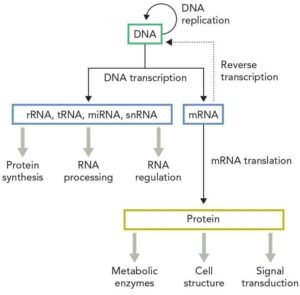
Protein synthesis has two major steps:
- Transcription (DNA → mRNA)
- Translation (mRNA → Protein)
Let us understand both steps in very simple language.
Step 1: Transcription – Making the Message (DNA to mRNA)
Imagine DNA as the “Master Book of Life” kept safely inside the nucleus of the cell. This book has thousands of recipes (genes). Each recipe tells how to make one specific protein.
When the body needs a particular protein (say insulin when you eat food, or keratin when your hair grows), the cell opens only that specific page (gene) of the DNA book.
An enzyme called RNA polymerase acts like a photocoplier. It reads that opened gene on DNA and makes a temporary copy called messenger RNA (mRNA).
Video
Important points:
– DNA never leaves the nucleus — it is too precious.
– mRNA is the messenger that carries the copy of the recipe out of the nucleus into the cytoplasm.
– The language of DNA and mRNA is the same triplet codon language (3 letters = one word = one amino acid).
– Example: DNA has the code TAC → mRNA will have AUG (because C pairs with G, but A pairs with U in RNA).
So transcription = copying the gene from DNA into mRNA inside the nucleus.
Step 2: Translation – Building the Protein (mRNA to Protein)
Now the mRNA comes out of the nucleus and goes to a factory in the cell called the ribosome (looks like a small grain under microscope).
The ribosome reads the mRNA message three letters at a time (one codon = one word).
Another type of RNA, called transfer RNA (tRNA), works like a delivery boy. Each tRNA carries one specific amino acid on top and has an anticodon at the bottom.
Example:
– If mRNA says AUG → a tRNA with anticodon UAC comes and brings the amino acid Methionine.
– Next codon, say AAA → another tRNA with anticodon UUU comes and brings Lysine.
The ribosome joins the amino acids one by one like beads in a chain. This chain of amino acids folds itself into a proper shape and becomes a functional protein.
So translation = reading mRNA codons and joining correct amino acids to form a protein.
The whole process is called Central Dogma of Biology:
DNA → Transcription → mRNA → Translation → Protein
The 64 codons represent the full set of instructions for protein synthesis, where each sequence of three mRNA nucleotides (a codon) specifies a particular amino acid or a stop signal. There is certain ways through which we must read the codon.
How does the cell know which protein to make and when to make it?
This is the most beautiful part — the cell is not making all 20,000–25,000 proteins all the time. That would waste energy. Instead, it makes only the required protein at the right time and in the right amount. This control is called gene expression or gene regulation.
Here are the simple ways cells decide:
-
Signals from inside or outside the body
– When you eat food → glucose level rises → pancreas cells get signal → they switch on the insulin gene → insulin protein is made.
– When you exercise → muscle cells get signal → they switch on genes for muscle repair proteins.
– When bacteria attack → immune cells switch on genes for antibodies.
-
Hormones act as messengers
Example: After eating, intestine releases a hormone → it travels in blood → reaches liver → liver cells switch on genes to make enzymes that store extra glucose.
-
Transcription factors – the main switches
These are special proteins that act like “on/off” switches for genes.
When a signal comes, certain transcription factors become active → they stick to the DNA near a gene → they either help RNA polymerase start transcription (switch on) or block it (switch off).
-
Enhancers and silencers
These are special DNA sequences far away from the gene that act like volume controls — they can increase or decrease how much mRNA is made.
-
Epigenetics – chemical tags on DNA
Some genes get “silenced” by adding methyl groups (like putting a lock). These locks can be passed from parent cell to daughter cell. That is why liver cells only make liver proteins and never make brain proteins, even though they have the same DNA.
-
In bacteria and simple organisms – operons
Example: Lac operon in E. coli. When lactose is present, the bacteria switch on genes to make enzymes that digest lactose. When lactose is absent, those genes are switched off. Very smart energy saving!
-
During development of baby
Different genes are switched on at different times. First genes for heart, then brain, then limbs — all controlled by master regulator genes.
Summary in simple words:
Every cell has the same DNA (complete recipe book), but it reads only the recipes it needs at that moment.
The decision “which protein, when, and how much” is controlled by:
– Chemical signals (nutrients, hormones, stress)
– Transcription factor proteins (on/off switches)
– Enhancers/silencers (volume control)
– Epigenetic marks (locks on DNA)
Protein synthesis is like a perfectly managed kitchen:
– DNA = master recipe book locked in safe (nucleus)
– Transcription = chef takes photocopy of one recipe (mRNA)
– Ribosome = cooking station
– tRNA = assistants bringing correct ingredients (amino acids)
– Transcription factors and signals = the head chef who decides which dish to cook today
This beautiful, precise system has been running inside every cell of your body non-stop since the moment you were conceived — billions of proteins are being made and replaced every day, all perfectly controlled.
That is why protein synthesis is truly the heartbeat of life.